Small

6 generations

1978 → 1999

Toyota Tercel – Technical Specifications & Generations

The Toyota Tercel occupied B-segment territory as Toyota's entry-level global offering from 1978 to 1999, bridging the gap between kei-class microcars and the Corolla. Spanning six generations and 117 documented variants in the Automobilisto database, the Tercel served markets worldwide with front-wheel-drive architecture and transverse engine layouts that became industry standard. Its role evolved from basic transportation to a platform demonstrating Toyota's powertrain efficiency and packaging innovation across two decades.

Discontinued 1999Updated 2026-08-04117 variants documented0 archive brochures
Toyota Tercel 5 generation, restyling
1997 - 1999
5 generation, restyling
Toyota Tercel 5 generation
1994 - 1997
5 generation
Toyota Tercel 4 generation
1990 - 1994
4 generation
Toyota Tercel 3 generation
1986 - 1990
3 generation
Toyota Tercel 2 generation
1982 - 1982
2 generation
Toyota Tercel 1 generation
1978 - 1982
1 generation
Yauheni Kapliarchuk
Last technical audit 2026-08-04 · two-source verified against Automobilisto catalog database.
First year1978
Final year1999
Generations6
Final chassisEL5
Body types5Coupe · Mini 3-doors · Sedan · Mini 5-doors · Estate 5-door

Generation picker

Open any chassis code for its dedicated generation reference

Current5 generation, restyling 1997 — 1999
CoupeMini 3-doorsSedan

The 1997–1999 restyling concluded Tercel production with 20 variants maintaining the 67–94 PS petrol and diesel range across coupe, three-door and sedan formats, closing a 21-year chapter as the Yaris and Echo prepared to redefine Toyota's small-car strategy.

Variants3
5 generation 1994 — 1997
CoupeSedanMini 3-doors

Generation five (1994–1997) offered 26 variants with coupe, three-door and sedan bodies, power outputs spanning 65–94 PS, and continued diesel availability, consolidating the model's position as Toyota's cost-efficient global B-segment workhorse before segment consolidation began.

Variants3
4 generation 1990 — 1994
Mini 3-doorsCoupeSedan

The fourth generation (1990–1994) peaked at 31 variants with coupe, three-door and sedan configurations, maintaining the 67–115 PS range and dual-fuel strategy, demonstrating platform maturity and Toyota's ability to extract maximum market coverage from a single architecture.

Variants3
3 generation 1986 — 1990
Mini 5-doorsMini 3-doorsCoupe

Generation three (1986–1990) introduced diesel powertrains alongside petrol, offered 17 variants across coupe and three/five-door bodies, and raised the performance ceiling to 115 PS, reflecting late-1980s efficiency and performance demands in compact segments.

Variants3
2 generation 1982 — 1982
SedanEstate 5-doorMini 5-doorsMini 3-doors

The second generation (1982) expanded dramatically to 22 variants spanning sedan, three-door, five-door and estate body types, with petrol engines ranging 64–85 PS, marking Toyota's commitment to segment diversification and global market adaptation.

Variants4
1 generation 1978 — 1982
Sedan

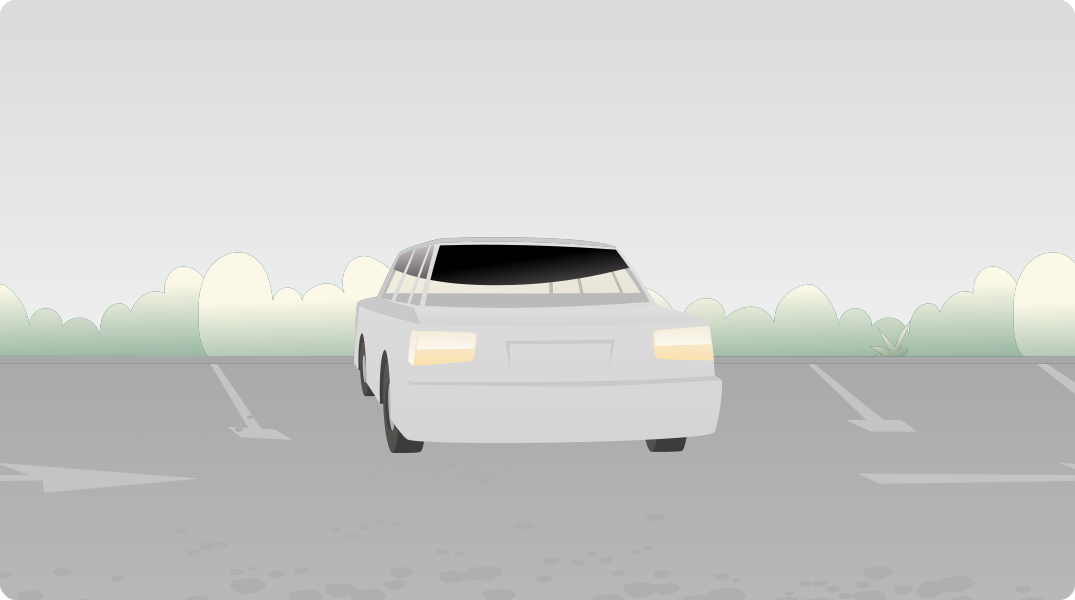
The first generation (1978–1982) launched with a single 65 PS petrol sedan variant, establishing Toyota's longitudinal front-engine, front-wheel-drive layout that would define early small-car engineering before transverse configurations prevailed.
Variants1

Full powertrain matrix (EL5, 1999)

Every engine × drivetrain combination currently available in the German market

Loading variants…

Generation lineage

Each generation at a glance, oldest to newest

AL101 gen.1978 — 19821 variants
AL202 gen.1982 — 19824 variants
EL303 gen.1986 — 19903 variants
EL414 gen.1990 — 19943 variants
EL53L5 gen.1994 — 19973 variants
EL53L5 gen. rest.1997 — 19993 variants

How the model evolved

Toyota built six Tercel generations between 1978 and 1999, progressing from a single-variant economy sedan to a diversified B-segment lineup encompassing sedans, coupes, three-door hatchbacks, five-door hatchbacks and estates. The first generation pioneered front-wheel drive in Toyota's global portfolio with a longitudinal engine orientation, while the second generation's shift to transverse layouts and 22-variant expansion signaled Toyota's intent to dominate entry-level markets through body-type proliferation. Peak variant count arrived with the fourth generation's 31 configurations, leveraging mature platform engineering to address regional preferences from North America to Europe to Asia-Pacific. Powertrain bandwidth grew from 65 PS in 1978 to a 64–115 PS range by the early 1990s, with diesel options appearing in 1986 to serve European fuel-tax regimes. The model's body-type roster contracted in later generations as Toyota consolidated around sedan and coupe formats, reflecting market migration toward larger B-segment hatchbacks and the emerging subcompact crossover category. By 1999, the Tercel's role as Toyota's global entry point had been superseded by the Yaris in most markets and the Echo nameplate in North America, ending production without a direct successor bearing the Tercel name. The model's legacy lies in establishing front-drive small-car credibility for Toyota and demonstrating how a single platform could be stretched across two decades and more than a hundred variants through disciplined engineering iteration.

Market context

The Tercel served as Toyota's primary B-segment contender in North America, Europe, Asia-Pacific and Latin America, competing against Honda Civic, Volkswagen Polo and Nissan Micra across its lifespan. Its global footprint reflected Toyota's strategy of using a single architecture to meet diverse regulatory and consumer demands, from emissions-conscious European markets requiring diesel variants to North American buyers prioritizing sedan and coupe formats. Production ended in 1999 as segment expectations shifted toward larger cabins and the Yaris/Echo replaced the Tercel nameplate globally.

Frequently asked questions about Tercel

How many generations of the Toyota Tercel were produced?

Toyota produced six Tercel generations from 1978 to 1999, including a fifth-generation restyling. The Automobilisto database documents 117 variants across all generations spanning sedans, coupes, hatchbacks and estates.

What body types were available for the Toyota Tercel?

The Tercel lineup included sedan, coupe, three-door hatchback, five-door hatchback and five-door estate body types across its production run, with availability varying by generation and market.

Did the Toyota Tercel offer diesel engines?

Diesel powertrains became available starting with the third generation in 1986 and continued through the final 1997–1999 restyling, primarily serving European and select Asia-Pacific markets alongside petrol variants.

What replaced the Toyota Tercel?

No direct successor carried the Tercel nameplate. The Yaris assumed the B-segment role in most global markets from 1999, while North America received the Echo nameplate before Yaris adoption in the mid-2000s.

What was the power output range for the Toyota Tercel?

Documented Tercel variants spanned 64 to 115 PS across petrol and diesel engines, with the lowest outputs in early generations and the 115 PS peak appearing in third and fourth generations from 1986 to 1994.