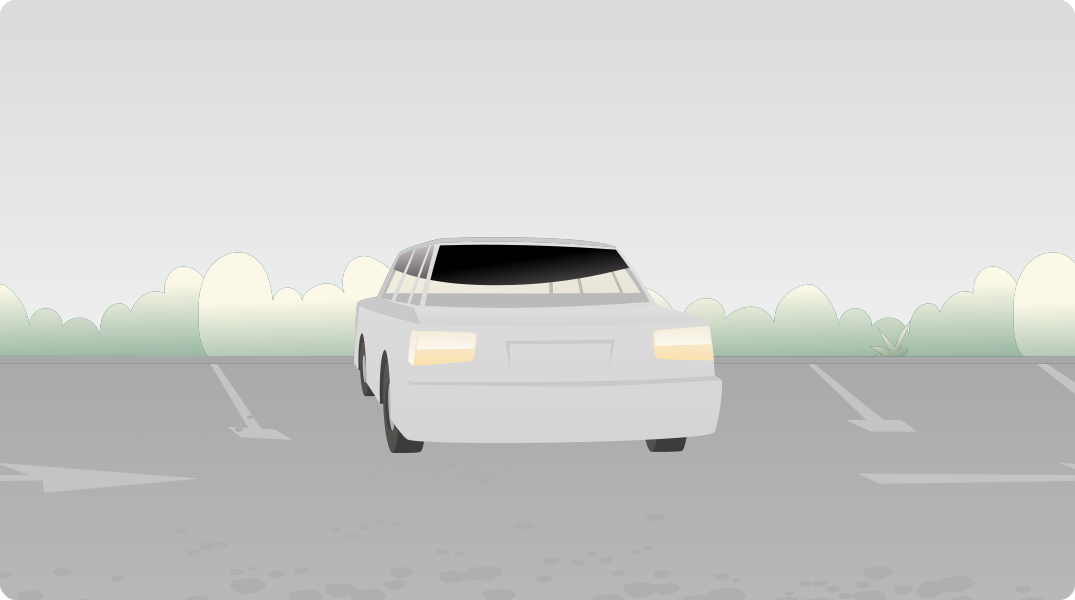
MPV

4 generations

2003 → 2017

Toyota Wish – Specifications & 4 Generations

The Toyota Wish carved out a niche in the compact MPV segment from 2003 to 2017, offering Japanese-market buyers a practical alternative to traditional minivans. Built across two generations with mid-cycle updates, the Wish combined car-like dimensions with flexible seating for up to seven occupants. Documented variants in the Automobilisto database: 13 across four distinct phases.

Discontinued 2017Updated 2026-08-0413 variants documented0 archive brochures
Toyota Wish 2 generation, restyling
2012 - 2017
2 generation, restyling
Toyota Wish 2 generation
2009 - 2012
2 generation
Toyota Wish 1 generation
2003 - 2005
1 generation
Yauheni Kapliarchuk
Last technical audit 2026-08-04 · two-source verified against Automobilisto catalog database.
First year2003
Final year2017
Generations4
Final chassisZGE20G, ZGE20W, ZGE22W, ZGE25G, ZGE25W
Body types2Minivan · Compact Van

Toyota Wish

2012 - 2017
2 generation, restyling
2005 - 2009
1 generation, restyling

Full powertrain matrix (ZGE20G, ZGE20W, ZGE22W, ZGE25G, ZGE25W, 2017)

Every engine × drivetrain combination currently available in the German market

Loading variants…

Generation lineage

Each generation at a glance, oldest to newest

11 gen.2003 — 20051 variants
11 gen. rest.2005 — 20091 variants
22 gen.2009 — 20121 variants
22 gen. rest.2012 — 20171 variants

How the model evolved

Toyota built four distinct phases of the Wish between 2003 and 2017, spanning two full generations with mid-cycle refreshes for each. The first generation ran from 2003 to 2009, initially classified as a compact van before evolving market definitions shifted the category. Power outputs remained consistent across the early years, with petrol engines delivering between 125 and 155 PS depending on variant and model year. The second generation launched in 2009 brought a platform update and reclassification to minivan status, reflecting the model's positioning against both traditional MPVs and crossover alternatives. Engine outputs climbed slightly to a peak of 158 PS in 2009–2012 variants before settling to 130–152 PS in the final 2012–2017 phase. Across its 14-year production run, the Wish maintained a consistent three- or four-variant strategy per generation, avoiding the proliferation of trim levels seen in some competing models. The absence of diesel or hybrid powertrains kept development focused on petrol efficiency improvements. When production ended in 2017, Toyota did not designate a direct replacement, leaving the compact MPV segment to crossover SUVs that had steadily eroded demand for car-based people movers.

Market context

The Wish primarily served Japanese domestic buyers seeking compact dimensions with multi-row seating, a segment that thrived in urban Asia during the 2000s. Its classification evolution from compact van to minivan mirrored shifting regulatory and marketing definitions rather than fundamental redesign. The model's 2017 discontinuation reflected global consumer migration toward crossover SUVs, which offered similar practicality with perceived lifestyle appeal.

Frequently asked questions about Wish

How many generations of Toyota Wish were produced?

Toyota produced two generations of the Wish from 2003 to 2017, each receiving a mid-cycle restyling, resulting in four distinct phases documented in the Automobilisto database.

What engine power range did the Toyota Wish offer?

Across all generations, the Wish used petrol engines ranging from 125 PS in early variants to a peak of 158 PS in second-generation models, with most variants delivering between 130 and 155 PS.

Was the Toyota Wish classified as a van or minivan?

The first generation (2003–2009) was classified as a compact van, while the second generation (2009–2017) carried minivan designation, reflecting evolving market categorization rather than fundamental body changes.

What replaced the Toyota Wish after 2017?

Toyota did not designate a direct successor to the Wish when production ended in 2017, as crossover SUVs had largely supplanted the compact MPV segment the model once occupied.